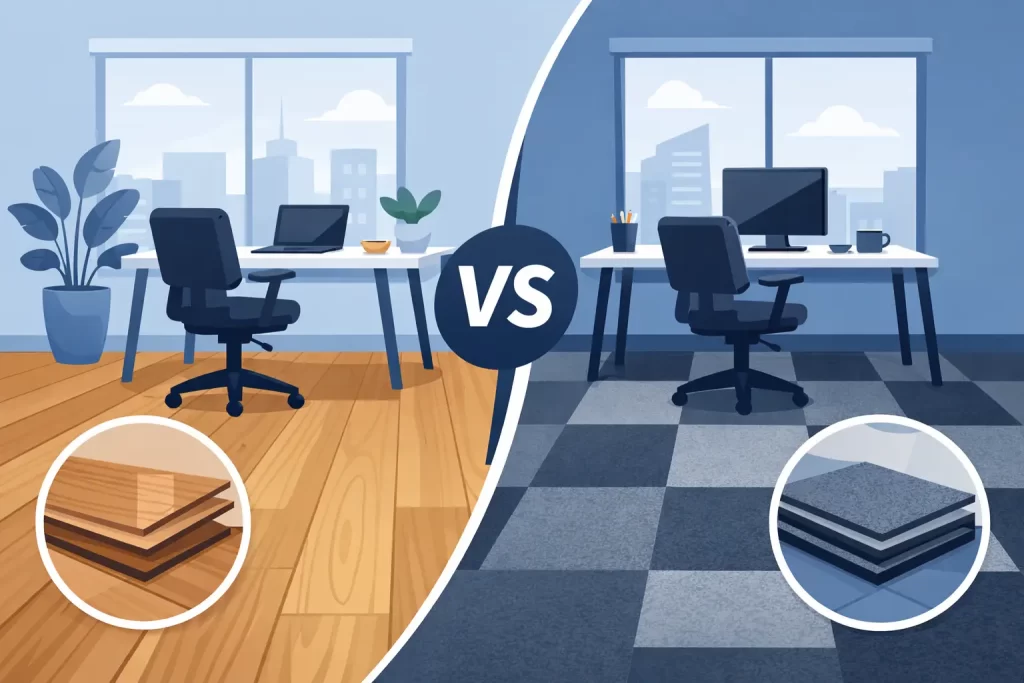
When an office floor is due for replacement, the real question is rarely just appearance. In most commercial projects, vinyl flooring vs carpet tiles comes down to noise, maintenance, programme risk and how much disruption the business can absorb while works are carried out. For facilities and workplace teams, that decision needs to be practical from day one, not just visually acceptable at handover.
Some spaces clearly suit one product more than the other. Others need a mixed approach. The right answer depends on how the office is used, how often the floor needs to be accessed or repaired, and whether the installation can happen in a live environment with desks, IT equipment and staff areas still in place.
Vinyl flooring vs carpet tiles in commercial settings
In broad terms, carpet tiles remain the default choice for most open-plan offices, meeting rooms and desk areas because they manage sound well, feel warmer underfoot and offer simple localised replacement if individual tiles are damaged. Vinyl flooring is often the stronger option in welfare areas, receptions, kitchens, circulation routes and spaces where spillages or frequent cleaning are expected.
That does not mean one is better across the board. It means each product solves a different operational problem. Commercial flooring decisions work best when they are based on how the space performs, not on a generic preference for hard or soft finishes.
What carpet tiles do well
For most occupied office environments, carpet tiles offer the best balance of practicality and day-to-day comfort. Acoustics are a major reason. In busy workplaces, hard flooring increases reflected sound from foot traffic, chair movement and general activity. Carpet tiles reduce that background noise and help create a more controlled working environment.
They also support phased replacement more effectively. If one section is worn, stained or damaged, individual tiles can be lifted and replaced without affecting the entire floor. That matters in commercial buildings where churn, furniture movement and heavy use can quickly create isolated problem areas.
Another advantage is flexibility. Carpet tiles work well in raised floor environments and in offices where under-desk cabling, power access and service routes need to remain accessible. They are also available in a wide range of colours, textures and patterns, which helps workplace teams zone space, manage wear patterns and maintain a professional finish over time.
For clients focused on continuity, carpet tiles often fit better with low-disruption replacement methods. In the right setting, specialist teams can replace flooring in phases, after hours or at weekends, keeping furniture and equipment in place and avoiding the usual operational shutdown associated with large flooring projects.
Where vinyl flooring has the advantage
Vinyl flooring earns its place where hygiene, cleaning and moisture resistance carry more weight than acoustic control. Tea points, breakout kitchens, printer stations, entrance zones and washroom approaches are common examples. These are areas where spills, tracked-in moisture and regular mopping are part of normal use.
In those environments, vinyl can be easier to maintain and more resilient against staining. It also delivers a crisp, clean visual finish that suits certain contemporary office schemes, particularly in front-of-house spaces where first impressions matter.
There is also a durability argument in some traffic-heavy zones. A well-specified commercial vinyl floor can perform strongly under rolling traffic and repeated cleaning regimes. That said, performance depends heavily on specification, subfloor condition and installation quality. Cheap vinyl in a demanding office environment often looks tired quickly, especially if the substrate preparation has been cut back to save cost.
Cost is not just the supply rate
Budget discussions often start with material cost per square metre, but that is only one line in the total project picture. The better comparison is whole-life cost plus installation impact.
Carpet tiles may be more cost-effective over time in standard office areas because damaged sections can be swapped out locally rather than replacing a full field of flooring. They can also reduce the need for wider redecoration or acoustic mitigation.
Vinyl can look attractive on an initial rate basis in some schemes, but the subfloor usually needs more attention. Hard flooring shows imperfections far more readily than carpet tiles. If the base is uneven, damaged or contaminated with old adhesive, preparation costs can rise quickly. In an office refurbishment, that additional prep can affect programme length, access requirements and out-of-hours scheduling.
For procurement teams, the useful question is not which product is cheaper on paper. It is which option gives better value once downtime, access constraints, replacement cycles and maintenance demands are factored in.
Acoustics, comfort and staff experience
This is where office projects often separate into obvious choices. Carpet tiles generally outperform vinyl in working areas because they absorb sound and make large floorplates feel calmer. In occupied offices, that can have a measurable effect on comfort, concentration and perceived quality.
Vinyl is harder underfoot and louder in use. Neither point rules it out, but both should be considered carefully in desk-heavy environments. A floor that looks smart at practical completion can still be the wrong operational choice if it increases noise complaints or makes the office feel more clinical than intended.
If the aim is to support focused work, reduce echo and create a softer feel under constant footfall, carpet tiles are usually the stronger fit. If the aim is fast cleaning and resilience against moisture, vinyl may justify the trade-off.
Installation disruption matters as much as product choice
One of the biggest mistakes in office flooring projects is choosing a finish without planning how it will actually be replaced. In live commercial space, disruption can cost more than the flooring itself.
Carpet tile replacement is often easier to phase around business operations, particularly when carried out by a specialist contractor with the right equipment, trained technicians and a clear project-managed sequence. In many occupied offices, desks, pedestals, filing systems and IT setups do not need to be fully cleared if the contractor is set up to work around them safely and efficiently.
Vinyl installation can be more restrictive. Depending on the product and adhesive system, larger uninterrupted areas may be needed. Subfloor preparation is often more critical, and drying or curing times can affect access. In practical terms, that can mean more planning around staff movement, more temporary decanting and tighter control of programme windows.
For businesses that cannot afford daytime disruption, the method of installation should be part of the specification decision from the start.
How to choose between vinyl flooring and carpet tiles
The best specification usually follows the function of each zone. Open-plan desking, meeting rooms and executive offices tend to favour carpet tiles because of acoustics, comfort and ease of ongoing maintenance. Kitchens, breakout refreshment points and high-risk spill areas often favour vinyl.
In many projects, the right answer is not vinyl or carpet tiles across the whole floorplate. It is a planned combination of both. That approach gives better operational performance and often better value than forcing one material into spaces where it is not ideally suited.
This is also where experienced commercial flooring advice makes a difference. Product selection should consider footfall, chair castors, cleaning regimes, access requirements, phasing, existing subfloor condition and how the office will continue operating during the works. Those details affect performance far more than showroom appearance.
Which option is better for occupied office refurbishment?
If the priority is minimal disruption in a live office, carpet tiles usually offer more flexibility. They are generally better suited to phased replacement, targeted repairs and working around occupied areas. For many commercial clients, that makes them the safer operational choice.
Vinyl remains a strong specification where the environment calls for it, but it needs to be chosen with a clear understanding of preparation, programme and access implications. Used selectively, it can be the right product. Used too broadly, it can create avoidable issues in acoustic comfort and installation logistics.
For that reason, many workplace projects benefit from a survey-led approach rather than a product-led one. A proper assessment of the existing floor, the building constraints and the business continuity requirements will usually show where vinyl adds value and where carpet tiles are the better long-term decision.
For office managers, facilities teams and property stakeholders, the most reliable route is to specify flooring around operational reality. A floor should not just look right on completion. It should be installable with no disruption where possible, maintainable without unnecessary cost, and fit for the way your teams actually use the space. If that decision needs weighing properly, start with a FREE site visit and a site-led recommendation rather than a guess.